

From password-protected pre-sales and poetry collections to David Lynch inspirations, frontman Jamie Hall unpacks the ambitious world-building behind the Brighton trio’s fourth album Nets to Catch the Wind…
Words by & photos Felix Bartlett (@bartlettfelixhc) | March 20, 2026
Tigercub know the value of patience. After a decade navigating the UK rock scene, initially riding in the slipstream of Royal Blood’s meteoric rise, later carving out their own darker, more cinematic path, the Brighton trio are ready to step into the light. Their fourth album Nets to Catch the Wind, arriving April 10 via Loosegroove Records, represents their most ambitious artistic statement yet: a record about futility, acceptance, and the strange liminal space between dreaming and waking.
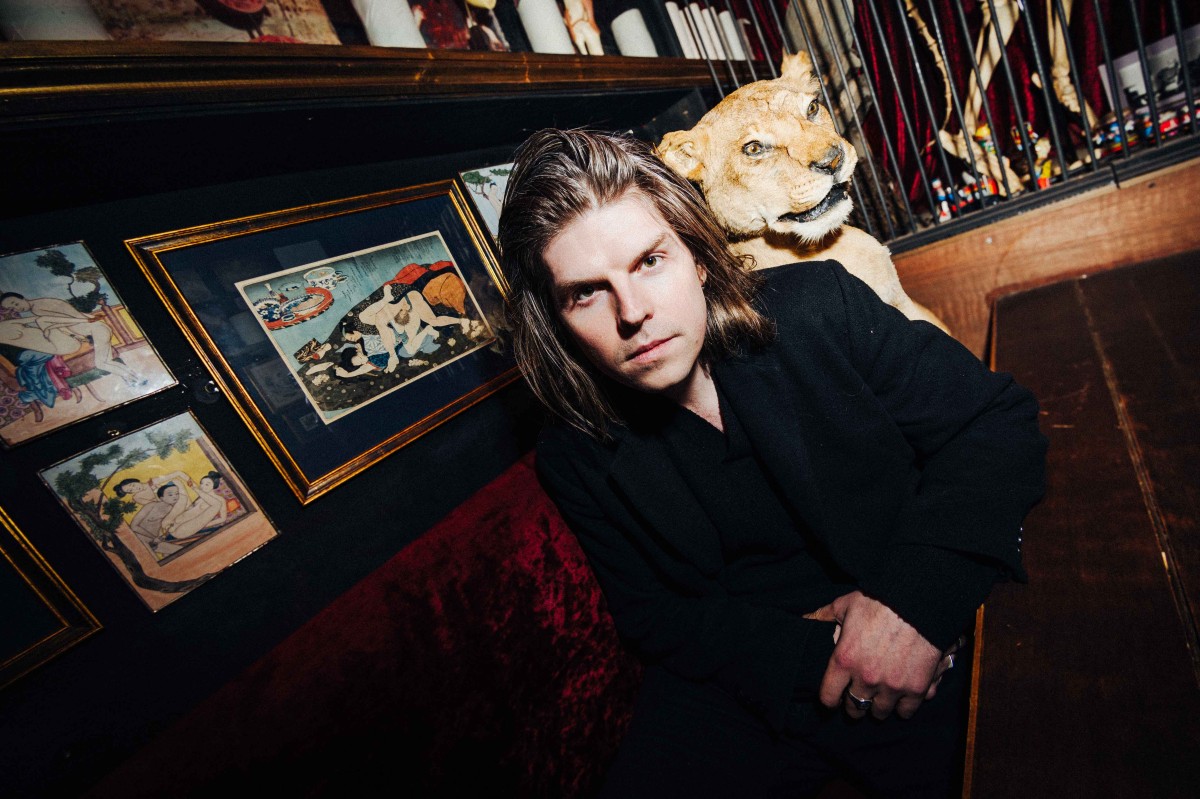
Meeting frontman Jamie Hall at The Last Tuesday Society & Absinthe Parlour in East London on a chilly January evening, there’s a palpable sense of transformation in the air. Hall, whose voice carries echoes of Jarvis Cocker’s theatrical baritone and whose conceptual ambitions match his literary influences,is in reflective form, nursing a cold that miraculously disappears after a shot of tequila (“Honestly, mate, it’s completely gone”).
Over the course of our conversation, as spirits flow and ideas tumble out, it becomes clear that Tigercub have arrived at a crucial moment, one where artistic vision and commercial ambition finally align.
First things first, let’s talk about the new album. The pre-sale sold out pretty much immediately, right? An incredible amount of copies?
“Yeah, we did alright!” Hall laughs. “What we like to do is run limited pressings of different variants, just to give people that have followed the band for a long time a bit of value added back, something that feels a little bit more personal in a world that’s so dominated by impersonal marketing. Especially with bands, it’s such an onslaught, just trying to cultivate and grow personal relationships with fans rather than just treating them as numbers.
“It feels good to offer fans an exclusive variant with a personal touch, something that’s going to be valuable on Discogs. We’ve always done that in the past, super limited runs to 500 or whatever. On our second record, we did a flexi disc with a track that’s not online. That’s the only way you can hear it, through this flexi disc. That just feels like, in this brave new world of the music industry, a human way to market your wares and continue the conversation with your fans as friends.”
The campaign itself was uniquely creative. Tigercub password-protected their website, with the password being Nets to Catch the Wind, a reference to Elinor Wylie’s early 20th-century poetry collection. They drip-fed cryptic clues on Instagram, turning the pre-sale into an interactive puzzle.
“It restored my faith in humanity because we started to do that and certain fans caught on to it,” Hall recalls. “They were like, ‘Alright, this is the puzzle here. The website’s password protected. Let’s try and work it out.’ It was a really enjoyable part of marketing the record because it’s a chance for me to build out some of the pretentious ideas I have around record-making and things that I want to try and express. I can sort of build that world out for them more, and they can maybe get a little bit more insight into the record’s themes and the emotions I’m trying to portray.
“Our fans worked it out pretty quickly. It was a reference to this poetry collection by Eleanor Wylie called Nets to Catch the Wind, which is amazing. Just even getting people to discover that poetry collection in itself is a win. They cracked the code to the website, they sold out our first variant, and hopefully that’s reward in itself. Obviously they parted with their money, but they’ve got something really special that’s first in.”
I think a lot of musicians miss the mark with their albums, they almost miss what music is. You can go down the corporatization route, but ultimately, I think the best thing you can do as a musician is connect with people in a way that really opens doors to new ideas.
“Yeah, you’re trying to link with people and trying to get them to understand something which is ultimately quite abstract,” Hall agrees. “I always think that art, or music in general, its main purpose is to try and communicate something that’s inexpressible through words. That’s its whole function. It can be hard sometimes when you have to come up with a press quote, how do I encapsulate what this idea is into 250 words? It’s like a round peg in a square hole. So sometimes you have to try and take people on the journey to help them understand something which is just kind of ineffable.”
Nets to Catch the Wind has been described as the dawn after The Perfume of Decay. What’s changed for you creatively? It feels a little bit heavier, which I’m a big fan of.
“That’s cool, I appreciate that,” Hall says, visibly pleased. “I find I dissociate from my own thoughts and feelings. I don’t always know how I’m feeling, I’m quite a repressed person. I don’t know what’s bubbling under the surface and I can’t articulate it. I need to make art to try and communicate that, just as a form of self-expression, regardless of whether there’s an audience for it or not.
“Each record is almost like this purge. I get it down, we put it together, it becomes a record. The artwork comes together, the title comes together, the loose concept comes together. And then I look back on these records after years have passed, and I can put the pieces together and understand truly what that record meant for me at that time. But at the time, I’m so close to the canvas and I’m so detached from how I feel, I don’t know what it means. It’s quite a weird thing, it’s almost like you have to go back and decode the fragments of what I’m thinking.”
So what’s the journey been from your beginnings to now? What’s led you to this point?
“Each record for Tigercub, I’m the primary songwriter, so the songs come into life through my creation, which sounds insane, sounds like I’m a fucking megalomaniac, but it’s this fun or challenging process for me. I get to understand more about who I am as a person through the records that I make and the sentiments that are put out into the world.
“What I put out, I think, is loose enough for people to attach their own meaning to and find catharsis and solidarity in their own experiences. The idea is unfinished enough that they can attach their own meaning to it. It’s not just a closed circle of an idea. That for me is hugely rewarding, and yeah, that’s something that drives me to carry on creating art.
“I guess I’m starting to understand what my process is a lot more now, whereas before it was just like you make something, you connect the dots as best you can and try and present something to people that’s coherent, that has enough depth for people to go as deep as they want and they can still be rewarded. All my favourite bands do that. I love bands that make punk records where it is what it is, but my favourite artists are the ones that have this Russian doll thing, the more you scratch the surface, the more you get.”
I was listening to “Stuck in the Melancholy” and it really resonated with me. Can you talk about that track, the narratives and themes? It just had so many layers to it.
“That’s really nice that you listened to it and got something out of it,” Hall says warmly. “That to me is the name of the game, to connect. When I listen to a song by another artist and I’m like, ‘Oh fuck, that’s totally it. I didn’t know it until I heard this song. I didn’t know I’d arrived at this place, but they’ve fucking nailed it.’ That’s a beautiful thing. There’s healing in that. It provides a pathway forward.
“With ‘Stuck in the Melancholy,’ I love the concept that I’d landed on because it was treating sadness, depression, the sort of blinding fog of depression, as a place that you’re stuck in. It has a location. There’s a church with a bell that tolls. It’s the toll of the miserable that comes for me. There’s almost a helplessness to it. It’s a place that I have no control over. I’m stuck in it.
“I haven’t heard anything or found anything that personifies sadness as having a location. It was kind of slightly inspired by a Nick Cave track, ‘From Her to Eternity.’”


I was going to say, there’s some very Britpop influences that I was feeling. Maybe not obvious, but I’m getting a little bit of Jarvis Cocker in your vocals.
“That’s so awesome!” Hall exclaims. “I would never have put Jarvis Cocker in that. I love Jarvis, and my partner’s a sycophant for Jarvis. So This Is Hardcore and Different Class are a huge part of my musical diet. I guess I’m not surprised in the way that’s crept in, but the whole record, I was trying to make a concerted effort to delve more into lyric writing and the meaning behind words and how you can create a lyrical reference point for people rather than just big riffs and maximalist production, which is almost like a bit of a mask you can hide behind.
“Especially in the era we’re in with production being so accessible to artists, in your bedroom with your laptop, you get so much feedback from plugins and different things that can sometimes get in the way of the core of just what songwriting is, which is pen and paper. Words. What the meaning of words are and how you can put together combinations of words to give a sense of something. That was my attempt at burrowing deeper into that world.”
Walking through London listening to that, you feel that sort of connection with the bigger picture, other people seeing it the same way. You’re not alone in this crazy world.
“Absolutely. There’s a helplessness to it, and it’s a place that provides a pathway forward. When you’re stuck in the melancholy, there’s healing through it. That lack of the complete circle is what actually allows the listener to complete the circle with whatever context they have in their lives when they’re listening to it.
“There’s records I’ve heard, films I’ve watched, even fucking the orange, yellow, orange by Rothko. You look at it and you’re like, ‘I don’t know what this means, but I’m projecting a lot onto this. I’m healing a lot through this.’ There’s something about the incomplete circle which is complete. That’s all we have as humans, all I have of life is my own first-person perspective. That’s it. It’s individualistic by its nature, which is mental.”
That song was actually a collaboration, right?
“Yeah, that was a co-write I had with Dom from Nothing But Thieves. He’s such a nice guy. He really helped me break out of the fucking three-record bind I was in where I was just so baked into my own process, I was just getting the same results being thrown up over and over again. He had the grace to humour me, listen to my ideas and thoughts on songwriting, allow that to be a conversation, and then offer his own input on what he sees as valid in the art world and what works commercially.
“He just totally got it. He was a really fun collaborator. We had some really great conversations and phone calls. He just cares. You happen upon these people in your life where they just really care about music and they want to be involved with creative ideas. They’re happy to jump off the cliff with you. There’s no aspersions being cast on anything.”
What’s the track you’re most looking forward to people hearing, or the one you’re most proud of?
“The track I’m always most fond of on our record is ‘Cut the Eyes Out the Photographs,’ which comes towards the end. I generally just like the way that song came together, and the finished product just feels like full realization of what I hope that track could be.
“It’s about how the whole record is about futility and giving yourself permission to move on from something that’s been very troubling, hopefully a universal truth that people can relate to. As much as you try to burn away, get rid of the demons and ghosts of your past, they just keep returning. You can’t erase your past. It ultimately forms who you are. You have to just arrive at a place of acceptance and peace. The only way to move on from things that are troubling in your past is through ownership.
“That song ultimately represents ownership, and that’s part of the reason why I put it so late on in the record, to try and have a sense of resolve where there’s ownership and there’s peace that has been made through all the hardship.”

Tell me about the collaboration with Clutch on that track.
“We got Neil from Clutch to read out this spoken word bit. First we asked Faris from The Horrorsl, just because I know he’s got a shared appreciation with the Shangri-Las and that teen melodrama thing with spoken word, which I’m just obsessed with. He passed on it, which is fair enough. But Neil came in and was like, ‘Yeah, do you want to read this sort of half Edgar Allan Poe-inspired spoken word?’ And he was up for it. He did such a fucking fun job, absolutely killed it. We were completely over the moon with the performance he managed to capture.
“It’s this sick little Easter egg to have on the record. It’s a reference to ‘A Dream Within a Dream’ by Edgar Allan Poe. It largely amplifies some of the larger themes of the record, which is about dreams and the chaos between the moment of waking from your dream, you’re sort of half conscious but you’re still asleep. There’s this liminal space there which I’m always looking for as an artist, the in-between, the bit between two worlds colliding. Every time I can find that, I’m like, ‘Yes, I’ve landed on something really interesting’ because it can’t be pinned down easily with words. Maybe art can try and fulfil some kind of function there.”
Any plans to bring these collaborations to life? Maybe Neil or Dom joining you on stage?
“Yeah, that’d be cool. Obviously with things like that, they depend on the planets aligning. We’ve had it in the past where I texted Jamie Lenman one day and was like, ‘You want to come out and sing a song with us?’ He was like, ‘Yeah,’ and came to King’s Cross and just fucking rocked up at the show and sang a song with us. So it’s kind of random like that.
“With Neil, if we can bring him out on stage and he can provide that performance for us, we’d of course say yes to that. As far as what people can expect for our live show, we’re hoping, if the planets align, for special guests. We’re fortunate enough to be a band that has famous friends in other bands. We’ve been around the block enough times that we do have mates who are in much more popular bands, so we’ll see what we can pull out.”
Speaking of which, this fascination with the liminal, it sounds very David Lynch.
“It’s basically David Lynch’s whole career!” Hall laughs. “I watched Blue Velvet before I made the record. Honestly, I’d seen Eraserhead and Mulholland Drive and Twin Peaks, and I was like, ‘I should like this.’ But it wasn’t until I saw Blue Velvet, maybe the most accessible film he’s made, which is still fucking wild, that I was like, ‘Oh, it’s all a dream. This is the chaos of dreams.’ He does such a good job of it.
“Then I went back and watched everything and I got it. I really got into his philosophies on transcendental meditation and his worldview on creativity. As an artist, the goal is to try and find the weird blind spots, the grotesque, the counterpoint, the bit between two worlds colliding. You’re touching on something that’s relevant. It can get a little bit Spinal Tap in interviews where you’re like, ‘I don’t really know what I’m talking about. I’m deliberately pushing myself into a space where I don’t understand,’ but hopefully there’s new truths to be found in that space.”
And KOKO, that’s one of my most favourite venues. I remember when I was about 15 years old, going there and queuing up for hours. To be playing that is pretty sick. How are you feeling about it?
“KOKO for us is a step up. It’s a larger room, but it just feels like a statement. It represents where the band should be. We want to project out and showcase to the world at large, the music industry, that we’re a big band in waiting and we’re ready to take the necessary steps to prove that we’ve earned our spot in that thousand-ticket-plus tier in the UK, Europe, and America. We just want to grow into that.
“What’s great is because it’s more people, you have a little bit more budget to work with. We can put on more of a complete lighting show and offer people something that spans across our old records. It’s a more fully realised version of Tigercub that suits a bigger stage. In the past it was just three blokes on stage, manfully struggling through their songs. Whereas KOKO, we feel is an opportunity to build out a show.”

This album feels ready for that. It feels deserving of the scale, it has that scope and that big sound.
“That’s so sick! I’m so excited,” Hall beams. “Not that I mean to be self-deprecating, I obviously back it to the max. You’re just so close to it. It hasn’t really registered to me that other people are gonna listen to it. I think it’s an ambitious record. It’s trying to get the absolute maximum it can out of its constituent parts without too much fucking smoke and mirrors, studio trickery. Just how can we make something that feels the absolute maximum, this huge, monolithic fucking unit of sound that can fill a large space?
“I think it would sound better on a big stage as opposed to a club. It’s slower, it’s mid-tempo, the tunings are lower, and it lends itself better to a larger space. We’re trying to step into those shoes.”
I know you’ve been compared to Royal Blood and Clutch quite a bit. Where do you see yourselves? Do you see Tigercub as pioneering, perhaps being the next band that takes up that mantle?
“When we first started out, Mick from Royal Blood would namedrop us a lot, and I guess that gave us a bit of cachet. We were part of that Brighton scene Royal Blood really exploded out of. He was gracious enough to shout us out and say, ‘This is good, this is worth your attention.’ We benefited from that.
“But as a byproduct of the success we enjoyed, we were always in the shadow of that and also seen as an also-ran. I’m hoping that as time progresses, the noise around Tigercub being a Royal Blood-style band will dissipate and all you’re left with is the music. People can make their own minds up about it and understand that there is a lot that’s different as much as there is in common with the whole rock music thing that happened in the 2010s.
“I think what I’ve always tried to offer is supreme emotional connection. I hope Tigercub’s cult status can realise itself as something way more than that. That people can maybe say we’ve helped move culture in our own way and not just been cynically marketed as an also-ran of Royal Blood, which is maybe some of the sentiment that’s followed us around through the last ten years of being a fucking band.
“I would like to think that there’s enough there in its own right that we’re offering to fans now that we can be elevated and put in our own secular paradigm of the music industry. We’ve put our fucking flag in the ground. Sometimes with certain bands, you just need ten years or so for the dust to settle and for that to be realized. Because we’ve always been an indie band, we’ve never been on a major label. I’m not bitter about it, but that’s been the way it is. So it’s a slow burn.
“I feel like because we’ve been on a slow burn, we’ve been on a longer trajectory which is now finally being realised. Hopefully Nets to Catch the Wind proves what Tigercub means to the people that care about it, that we own our own part of the vast musical tapestry and we can be appreciated for our own legitimate, unique voice in the world. That’s all we can hope for, really.”
As our conversation winds down and the absinthe parlour grows livelier around us, it’s clear that Tigercub have finally arrived at that place of acceptance Hall sings about. Ten years in, they’re no longer running from comparisons or chasing validation. Instead, they’re building their own world, one limited pressing, one cryptic password, one dream-state song at a time.
Nets to Catch the Wind is released April 10 via Loosegroove Records – catch them headline KOKO on March 26 and get your tickets now.


Leave a Reply