
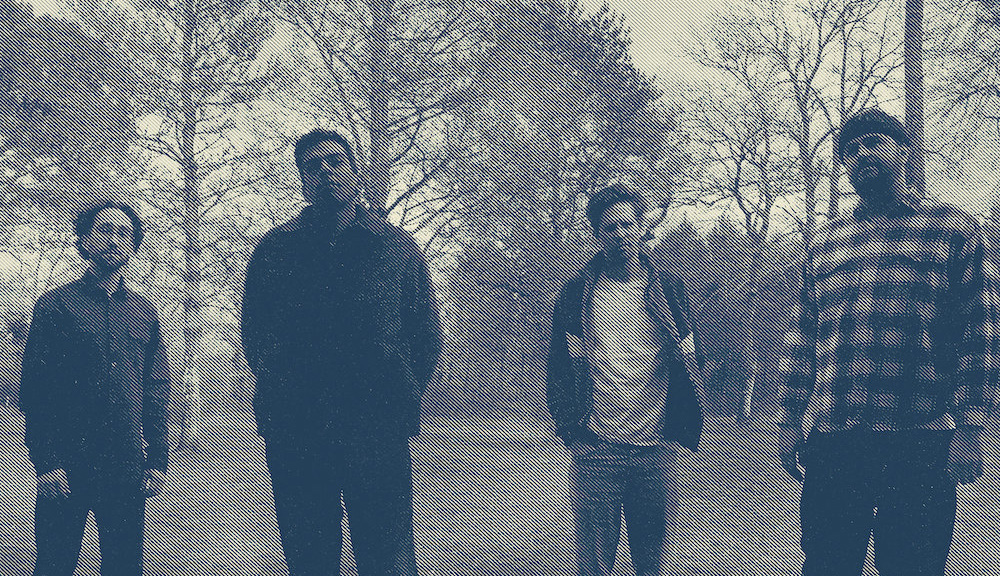

From a jazz festival in Lithuania to a haunted studio in rural France, the four-piece talk swapping songs for soundscapes ahead of their new EP…
Words by Felix Bartlett | July 16, 2026
Something odd happens about halfway through Millpool’s new EP. The tightly wound guitar interplay that opens the record starts to loosen, the songs stretch out, and what’s left sounds less like a conventional song and more like four musicians thinking out loud together. That’s not an accident. It’s the sound of a band who spent their first EP finding out what they were, and their second working out how far they can stretch it.
Millpool’s story starts, fittingly, somewhere unexpected: a jazz festival in Lithuania. “I’d been writing music for a long time but hadn’t really been making anything guitar based for a while,” says Joshua, recalling the trip that sparked the band with now-bandmate Ammar. “We started hypothesising about doing a project together and kind of started jamming.” A few lineup changes later, the current four-piece fell into place around pre-existing friendships. Alejandro has known Joshua since the pair lived in Vancouver over a decade ago, while Duncan and Joshua grew up together in Chester. “Everyone sort of wanted a bit of an escape, just to play music again,” Joshua explains. “No one had been doing it for a while, so it’s nice to do it together.”
The band’s name carries its own daft origin story. Their first gig was played under the considerably more ominous banner of Coward, “which is maybe a bit more impactful,” Joshua admits, “but there’s a lot of cowards out there, unfortunately.” Rather than compete for the title, they landed on Millpool instead, borrowed partly from an old demo called ‘Millpool Theme’ and partly, depending who you ask, from a Simpsons in-joke nobody in the band can quite agree on the details of. Joshua, for what it’s worth, keeps a running list of potential names for future use. “If you need a name for anything, come to me,” he laughs. “I’ve got so many.”
For the new EP, the band reunited with Misha Herring, who also worked on their debut. But where that first release stuck close to a conventional verse-chorus structure, the follow-up finds Millpool considerably more comfortable pulling songs apart. “The first EP, Josh would come with something close to a finished song and we’d contribute around it,” says Alejandro. “This time he was coming with fragments, little bits, and we had the comfort to say, well, this part’s great, but what if we make the next bit totally different.” That shift, he says, came down to trust built up over time. “We were more comfortable being a bit critical of our own suggestions. I think that led to newer directions.”
Ammar, who comes from a jazz background, describes a record built on instinct as much as intention. “We jammed a lot, leaning into improvisational sections and then stripping things back,” he says. “You get quite good at realising what fits and what works. When you land on the thing that works, you know it. The rest of the time you’re just searching.”
That searching led somewhere else entirely earlier this year, when the band decamped to a studio in rural France, owned by a friend of Alejandro’s, and self-engineered an entirely separate record. If the new EP is Millpool leaning into their sound, the France sessions are them abandoning it altogether. “It’s not really lo-fi,” says Ammar. “More like soundscapes,” Duncan continues. “Not as hardcore. No words.” Joshua puts some of that down to the setting itself. “It was really spooky there. I think there was some supernatural goings-on, and I think that contributes.” Four days locked away, some nights running into the early hours, gave them something considerably heavier and more sprawling than anything they’d made before. “It’s so rare to get that,” Ammar reflects. “To just sit down and record and see what happens.”
It leaves Joshua wrestling with a familiar tension: the pull between creative freedom and the community that got them here. “We’ve been quite lucky to be accepted by the punk, hardcore and post-hardcore world, and played some really awesome gigs,” he says. “We don’t want to lose that completely.”
Reconciling jazz, hardcore and electronic influences into one project was never a conscious decision, according to Duncan. “I don’t try to make it sound like anything, I just say what I think fits,” he says. “It’s a collective influence. I couldn’t tell you where it comes from, but it’s come from somewhere.” Alejandro sees it as a clash of instincts more than genres: Joshua leading on songwriting, and himself, shaped by electronic music and a jazz background of his own, thinking less in songs and more in “sequences, textures, ambience.” The France sessions leaned fully into that instinct, built less like a rehearsal and more like a studio production exercise. “We’d make a 40-second snippet and ask what happens if we paste it in front of this other bit,” he says. “Working in quite a different way to a rehearsal room.”
Lyrically, the EP touches on fatherhood and loss, though Joshua says the words rarely arrive in the same order twice. “Sometimes something’s dying to come out and you write it almost subconsciously, then realise later what it’s actually about,” he explains. “Other times you’re ruminating on something and try to write about it deliberately.” He compares it to standing in front of an abstract painting. “You wonder whether the artist had something specific in mind, or just attached a human emotion to it afterwards.”
London remains Millpool’s home base, and the band are eyeing a shift towards the city’s arts-led venues, Cafe OTO and the ICA among them, as a way of leaning further into the experimental side without cutting ties to the scene that raised them. “We’d love to play those kinds of places,” says Joshua. “It’s a bit of a seal of approval, isn’t it? Not that we’re not grateful for all the awesome venues and promoters we’ve gigged with already.” Ammar, meanwhile, is hoping to finally take the band beyond London. “We’ve only really done London and around there,” he says. “It’d be nice to find your community elsewhere too.” A recent gig at a converted bathhouse, watching Ben Vince and Al Wootton play through speaker stacks in what Joshua describes as “almost like a gymnasium,” has only sharpened the band’s appetite for unconventional spaces. “This would be a really special place to do a gig,” he says. “It fills me with excitement rather than dread.”
What comes next is shaped by that same tension between where Millpool started and where they’re headed. “The stuff coming out right now sounds really different,” Joshua says. “It’ll be interesting to see who follows the journey and who thinks it’s too weird.” The France record, envisioned as one continuous listen moving through different sections and movements rather than a collection of singles, is pencilled in for early 2027, with the band planning to release only fragments of it online in the meantime. “We’re trying to bring people into what we’re doing a bit more,” Joshua says, “rather than doing the push at everybody.”
It’s a question the band keep circling back to: who exactly Millpool is for. “Since our first gigs we’ve asked ourselves, are we hardcore enough for this scene, that kind of thing,” Alejandro reflects. “It’s not a big deal, but it is a real question: what audience are we trying to reach, how do we want to present ourselves. We’re curious to see who the new material resonates with, and honestly, we’ve started asking ourselves what bands we’d book if we put on our own show.” Given everything Millpool have thrown into the mix so far, from Lithuanian jazz festivals to haunted French studios, that lineup would probably be worth seeing too.
Millpool’s new EP is out July 17, with a vinyl pressing to follow the week after. Grab yours here
Leave a Reply