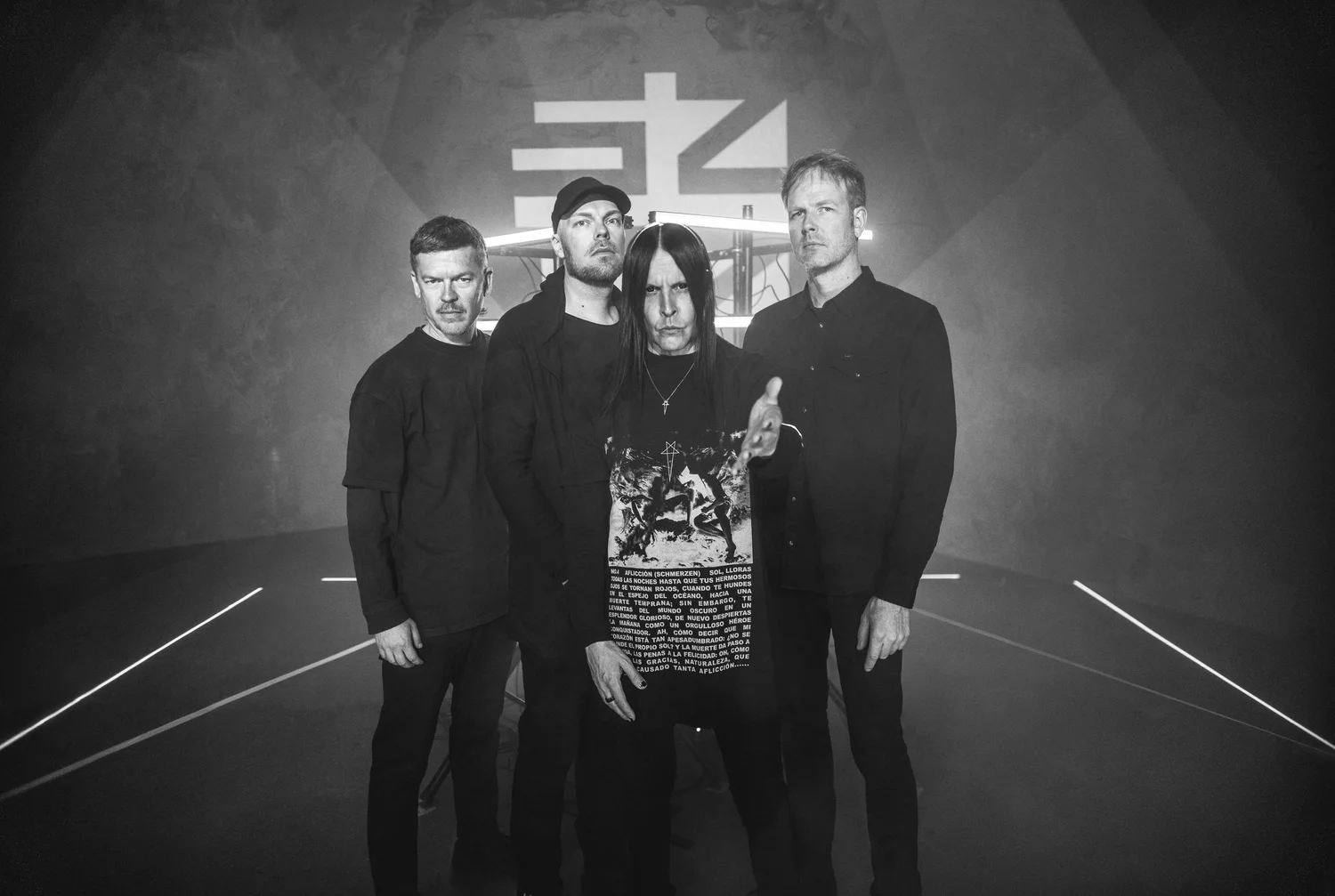

Thirty years and eleven albums into a legendary career at home, the Finnish alt-metal veterans are finally taking their eight-string riffs and native-tongue lyrics to the world, with a heavier new record already on the way…
Words by Cheryl Mann | Sep 24, 2026
Breaking the UK market as a Finnish metal band usually demands a conventional approach: adopting the English language. Yet Sara have never been a band to play it safe. Boasting a 30-year legacy of legendary status at home, the Finnish veterans are ready to unleash their dark alternative metal globally, and they are doing it entirely on their own terms, with their haunting native lyrics and relentlessly infectious riffs fully intact.
Evolving from their 90s and 00s party-era roots to modern, crushing eight-string riffs, Sara are finally venturing outside Finland to show the rest of the world their dangerously addictive music. Frontman Joa Korhonen sat down with us to delve into the band’s drive to connect with global listeners through the powerful, dark alternative metal of their new single “Harhailija” and upcoming 11th album Í heiminum, out January 22nd 2027…
During the 2000s “Finnish invasion”, most bands sang in English, but you stayed true to Finnish. Now, global audiences seem much more open to foreign-language music. Have you noticed this shift, and do you think this newfound acceptance is down to advances in technology (online translation apps) and fewer gatekeepers (social media, for example) giving fans direct access, proving they were open to it all along?
Joa: Yeah, there’s a couple of bands from Finland that have been singing in Finnish and finding new audiences outside Finland. And it may be because it sounds so unique. Everybody sings in English. There are always big bands singing in English. You know, there’s Rammstein, of course, but I don’t know why we kind of chose it. I never even thought about it, like, should we sing in Finnish or should we sing in English? When we started the band, it was just, yeah, we sing in Finnish because we are from Finland.
Many Finnish artists I’ve spoken with prefer writing in English because the language allows for more lyrical flexibility. Your lyrics, however, are deeply emotional and written entirely in Finnish. For you, does the Finnish language make it easier or harder to capture that level of depth?
Joa: I guess it would be easier in English in a way. I have some side projects that I sing in English, and you kind of get away with a lot of things singing in English. But when you sing in Finnish, it’s so raw. You really have to concentrate on what you’re saying.
I’m completely obsessed with your song “Anhedonia” right now. The contrast of the musical textures over those heavy riffs is addictive. When I love a track this much, I want the full backstory. What was the creative process like for this one? Did it change a lot from the first idea to the final release, or was it smooth sailing?
Joa: I think it was maybe one of the last songs that got made for the Hallava record, and it was quite smooth sailing. I remember that it started from the opening riff. I try to play guitar every day, and usually there are riffs just pouring out of me. I record them on my phone quickly and put them away. A lot of times I forget things and then I’m going through my phone like, oh, this sounds interesting. But it was kind of fast.
It’s always a little bit of a struggle with the lyrics. They take a bit more time. I’m quite fast with the music when I’m writing, and when I do the melodies, I actually sing in this weird language that sounds like English. That’s something that makes it special too when I work like that. But sometimes it’s really, really hard when you make a nice melody and you just can’t find the words to finish it. It’s so differently structured.
Your guitars sound and look phenomenal. As someone who is currently learning the basics on a six-string, I’m in awe of the work that goes into your music. I noticed you play an eight-string guitar. Is that something new you brought in to experiment and evolve your sound, or have you always used one?
Joa: It’s a new thing. Eight strings are definitely a new thing. When we started making records, we were listening to Deftones and Korn, and they were using seven strings at the time. But I’ve always liked low-tuned music. I always used pitch shifters and octavers in my sounds. The eight string is new, and it was weird to start playing. And still now, when you’re playing with eight strings a lot and then you get a six string, you’re totally lost. The strings are in the wrong places.
Evolving as a band is so important, yet new bands face immense pressure to be perfect instantly without room to grow. You’ve successfully evolved over three decades. Is your current sound purely a result of your own shifting life perspectives over the years, or do newer bands emerging on the scene also help inspire that growth?
Joa: We’ve played for 30 years, and it’s 10, 11 albums now. So you kind of get a bit sick and tired of riffs and guitar playing. After we did three albums with a bigger label, Universal Records, we drifted away from the heavier stuff. But you also need those kinds of moments where you drift off into some new world. Then you come back to it and find yourself again, and find the guitars. I’ve always liked guitars, new guitars, but in recent years it’s gotten a little bit out of hand. Always looking at new guitars, and now the eight strings and stuff like that.
It’s important to explore different elements in the music. You go forward and you grab the things that you like from it. When we listen to the first albums we made, it can make you start blushing a little bit, hearing yourself 30 years ago as a little boy. But you have to put it in your head that you did your best then. The thing we were making felt like the most important thing we were doing at the time, and that’s important.
Moving on to “Hyvästi kapteeni” (“Goodbye, Captain”). This track is a masterclass in vocal emotion. It literally made me cry before I even looked up the translation, proving music is entirely universal. Without getting too personal, could you share the inspiration behind this song for the fans finding it today?
Joa: It’s written for my late father. He was a captain. I’ve always written songs about close people who have passed away. It’s a way for me to get through the feelings when I lose someone, so it’s always been a great tool for that. When you’re performing the songs on stage, you don’t think about what the song is about that much anymore. Maybe here and there something bubbles up and you start remembering things and thinking about the lyrics, but it’s so automated when you’re performing. I’ve found it a great place to honour people who have passed. Everybody has someone they have lost. It’s a universal thing.
I just thought it was incredible that I felt that without knowing what the words meant at the time. It’s a testament to you as a songwriter and as someone who can deliver that type of vocal.
Joa: That is so cool to hear. I’m always thinking about how people hear our music, especially the lyrics and the language. I would like to be in their head and listen to it for the first time, not understanding what I’m singing. It would be so cool to know how it sounds.
I’m fascinated by the artwork for your last album, Hallava. It’s a deeply emotional, comforting photograph, and I highly respect your choice to use real photography. What’s the backstory to that cover? Was it a planned artistic shoot specifically for the album, or an accidental snapshot that just fit the mood perfectly?
Joa: It was a planned photo. I’m the one standing beside the horse. The idea for the cover came partly from the old image of Death riding a pale horse, and that connected really naturally with “Hyvästi kapteeni”.
The song was originally called “Hallava”. It’s an old Finnish word for a pale, greyish or faded colour, and it’s also the word traditionally used for the pale horse in that story. So I liked the connection between the horse, the idea of Death, and the song, which is about saying goodbye to my father. In my mind, the horse almost became the one coming to get him. So the photo wasn’t just about having a beautiful horse on the cover. There was a meaning behind it.
But then I wanted Hallava to become the album title, so I changed the song name to “Hyvästi kapteeni”, and the horse stayed on the cover. There’s something very powerful about standing beside such a beautiful creature. You have this huge respect for it.
Moving on to “Se osa joka rikkoo”, a track whose massive riffs have made it a real favourite of mine. The title translates to “The Part That Breaks”, and the lyrics seem to touch deeply on breaking away from self-destruction. Did I interpret that lyrical theme correctly?
Joa: Yes. It’s about addiction too. I wrote it a little while after I stopped drinking alcohol. It got to the point where I started getting panic attacks and different kinds of arrhythmia. My heart was beating all over the place, and I decided maybe it was time to try a different style of life for a while. That’s what it’s about. Now I occasionally drink, yes, but alcohol is a weird thing.
I’m not the only musician who speaks about this stuff. It’s all over the industry. But it’s gotten way better. When I look back at our shows back in the day, it was more about partying after the shows. Nowadays bands actually concentrate, and the show is the main thing, not the party after. It’s really unusual to see bands wasted on stage now. And when you look at the guitar players and all the musicians, they’re so much more talented. They’re way better than us. We’re going to keep trying to keep up with them!
How did you come up with the band name Sara?
Joa: Sara comes from our family dog. We had a boxer called Sara when I was a kid. But actually, if I started a band now, I would never call it Sara, because when you type Sara into any of the platforms, there’s a lot of music under that name. I have to fight with Spotify and the other platforms. It’s always a struggle.
That’s actually a really valuable point for new musicians to note when they’re thinking about their band name: make it easy to search for!
What else do we have to look forward to from Sara in 2026 and 2027?
Joa: An album is coming out on January 22nd 2027 called Í heiminum, and there will be singles too. It’s going to be a heavier album than the last one. And then there’s a tour coming up.
Finally, your new single “Harhailija”, meaning “Wanderer” or “Vagrant”, is out now. Can you tell us more about it?
Joa: The riff is heavily inspired by Rammstein. I watched a series called Task, where FBI agent Tom Brandis (Mark Ruffalo) compares his hostage-taker Robbie (Tom Pelphrey) to a “vagrant bird”, a bird that has strayed far outside its normal range and forgotten how to find its way home. I always find these lines in films, articles or series, and I write them on my phone so I will remember them. So this song is about that.
All of us have felt like, I’m lost and I can’t find the way back. Maybe we don’t need to find our way back. That home is somewhere in you. It’s not new stuff I’m writing about. I’m sure plenty of people have said that before or written lyrics about it, but it’s from my perspective and through my lens. It’s about losing yourself and getting lost in the world, but then finding yourself again.
That’s beautiful, and it’s a great song. I love how you’ve made that into something beautiful and hopeful.
Leave a Reply