


Norway’s most unpredictable trio are rolling downhill fast, and they have absolutely no intention of stopping.
Words by Tanita Hingerty | June 07, 2026
Certain bands arrive with a sense that they are building something genuinely their own. Oslo trio Hammok, comprised of Tobias, Benjamin and Ferdinand, are one of those bands. Ahead of the release of their new album When Does This Place Become Our Scene?, we sat down with the three of them to talk self-sabotage, skate parks, and why the hungriest beast alive runs on clean sheets and a warm meal.
The new video for “Tap Water” had quite an adventure behind it. Can you tell us about it?
Tobias: Yeah, the music video is a funny story. The location we shot at ended up being completely different from what it was meant to be. We had this whole plan of going out to this field with a bird watching house, and we showed up and it had snowed so much the night before that we had to abort the whole plan. We ended up shooting it at the local skate park we essentially grew up in, in our old hometown.
It just all came together in this very fun way. How we usually do things, we usually end up where we started, and it always comes back to that same spot where everything began. You can trace this whole band back to that skate park.
For that song, it deals a lot with self-sabotage and the appeal of self-sabotage. Being in a band in 2025/2026, the economy is kind of fucked, and being on the road is hard. You’re very poor, you’re struggling, and if it’s not that way all the time it can almost feel like it’s wrong. The consequence becomes the appeal. It becomes this self-eating, negative way of relying on self-sabotage, almost a myth of the tortured artist.
Benjamin: Which happens all the time.
Tobias: It does happen all the time, yeah.
It looked very cold in the video.
Tobias: It was so cold.
Benjamin: You should have seen the place when we first arrived. We were supposed to cross this field, we had to cross a golf course with so much snow. We put all our gear on a jack from the car and dragged it across the entire thing.
Tobias: We got halfway and the director, Chris, just said, yeah, no. When we arrive at this location it’s going to be night and totally worthless. So we went to the skate park, which ended up being so much more meaningful and cinematic. I’m very happy it happened but that was absolutely not the plan.
That song is from the new album, When Does This Place Become Our Scene?, out June 5th. How did the title come about?
Tobias: It beamed into my head. We were on tour for the first album, in the Netherlands, and I was in a hotel room. We’d already been working on the song “The Scene” and I started recording some scratch vocals under the pillows to not make too much noise. I came up with the first verse and just said, “When does this space become a scene, when does this place become our scene?” And that was it. Stop everything. This is the title.
It summed up everything we were feeling doing those shows, having an album out, playing it to people buying it and listening to it. I feel like it has so many levels. Some of my friends have asked, is this a diss against the Norwegian hardcore community? Is it hopeful? Disappointing? A call to action? I love that one sentence can mean so many things.
The title came when we had two songs done, and because it was already there it became this north star. It’s vague enough to justify anything you’re doing in that direction. It always feels very special when you get those moments, like God is beaming everything into your head. Not that I’m religious, but you know, one of those That’s So Raven moments where you can see everything clearly.
Everyone laughs.
What was the main inspiration behind the songs on the album?
Tobias: Before really making any songs, I was rediscovering a lot of early 2000s dance punk music. It started with me discovering The Police, and being fascinated with how three people could make everything so distinct. The guitar is doing one thing, the bass is doing another, they’re all complementing each other. Very skeletal but very powerful.
Then I got into Bloc Party, LCD Soundsystem, the Yeah Yeah Yeahs, and how they deal with rhythm and patterns. The thing that’s usually making it emotional is the bass doing all the harmonic lifting while the guitar does a simple repeating pattern. Think of “All My Friends” by LCD Soundsystem. You have this enormous emotional climax and you have no idea how you ended up there. It’s been growing in a loop, and if you think of that song in your head it becomes very big, but if you actually listen to it there’s barely anything going on. The illusion is so much bigger than the song itself.
I was trying to create that in our music. Reign it back, create the illusion, let the listener dream up parts on their own and hear things that aren’t there.
The album varies a lot in sound and style. How did you each develop your own musical identity?
Tobias: I’ve never really cared about purposefully having a style. It just happens. If the thing you’re chasing is just to copy something, that’s very uninteresting to me. I love getting inspired by the concept of what someone is doing. The concept of LCD Soundsystem is what if the guitar does a short loop and the bass does the emotion. That’s a great concept. You can do ten years on that concept.
The best feeling in the world is not knowing where you are, whether you’re watching a film, at a show or listening to an album. If somebody can catch you off guard, that is all I want. A lot of the making of this album is trying to create those moments in a room, and if you can surprise yourself, stop everything, we’re chasing that.
Benjamin: The difference between what Tobias is talking about and people who are copying others rather than a concept is so obvious. I’m not going to mention names, but recently we were playing a show and there were a lot of artists playing, and it was like, oh, there are artists copying other people again. There are so many of them.
From the new album, do you each have a favourite song or one you’re most looking forward to playing live?
Tobias: We just played a show where we performed some of the new songs live for the first time, which was very eye-opening. “Blast Off” will always be special to me. It’s a song nobody else can make but this band, and I believe that wholeheartedly. It defined the whole album.
Benjamin: Mine was “CND”. It’s a long time since I felt so much swag on stage. Probably because the bass was so loud that when I hit the first note it just felt so cool.
Ferdinand: Mine has always been “Groundbreaker”, but after playing “CND” it felt super special.
Benjamin: A lot of swag, you and me man, bass and drums, swagging around the stage.
You’ve got UK shows coming up including 2000 Trees festival. What can people expect from a Hammok live show?
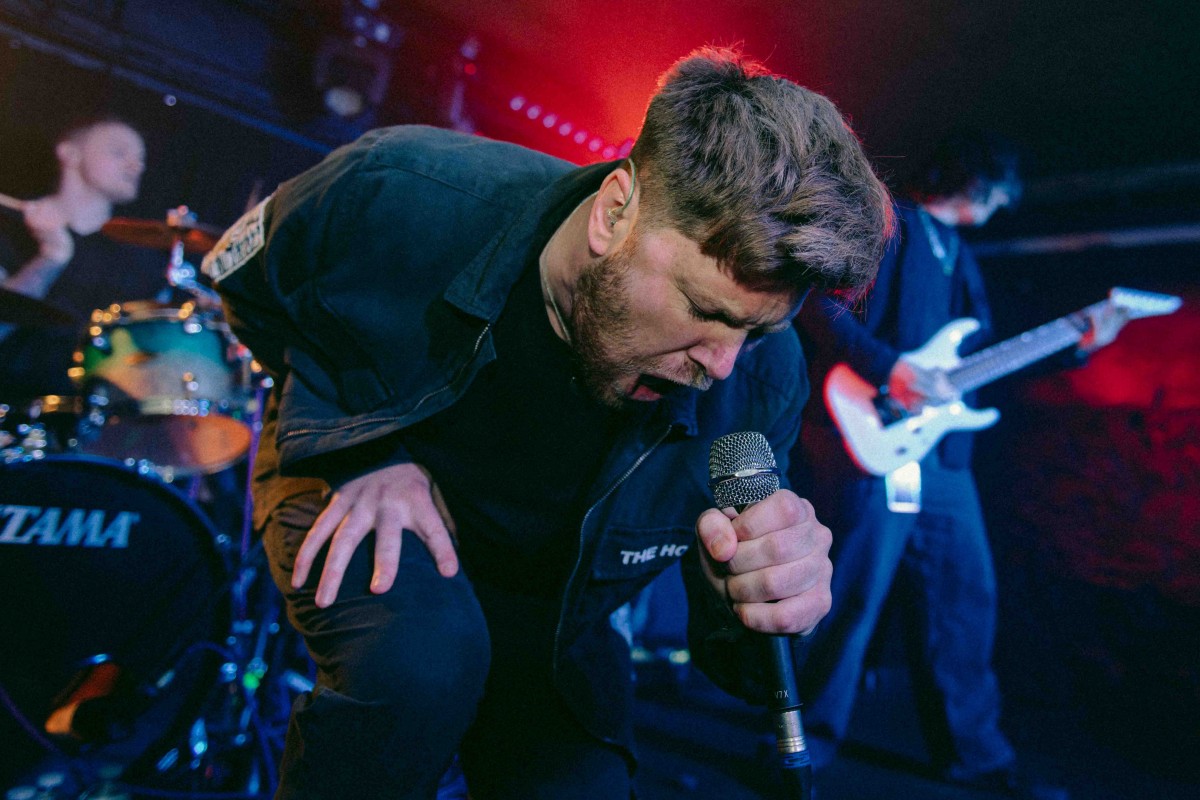
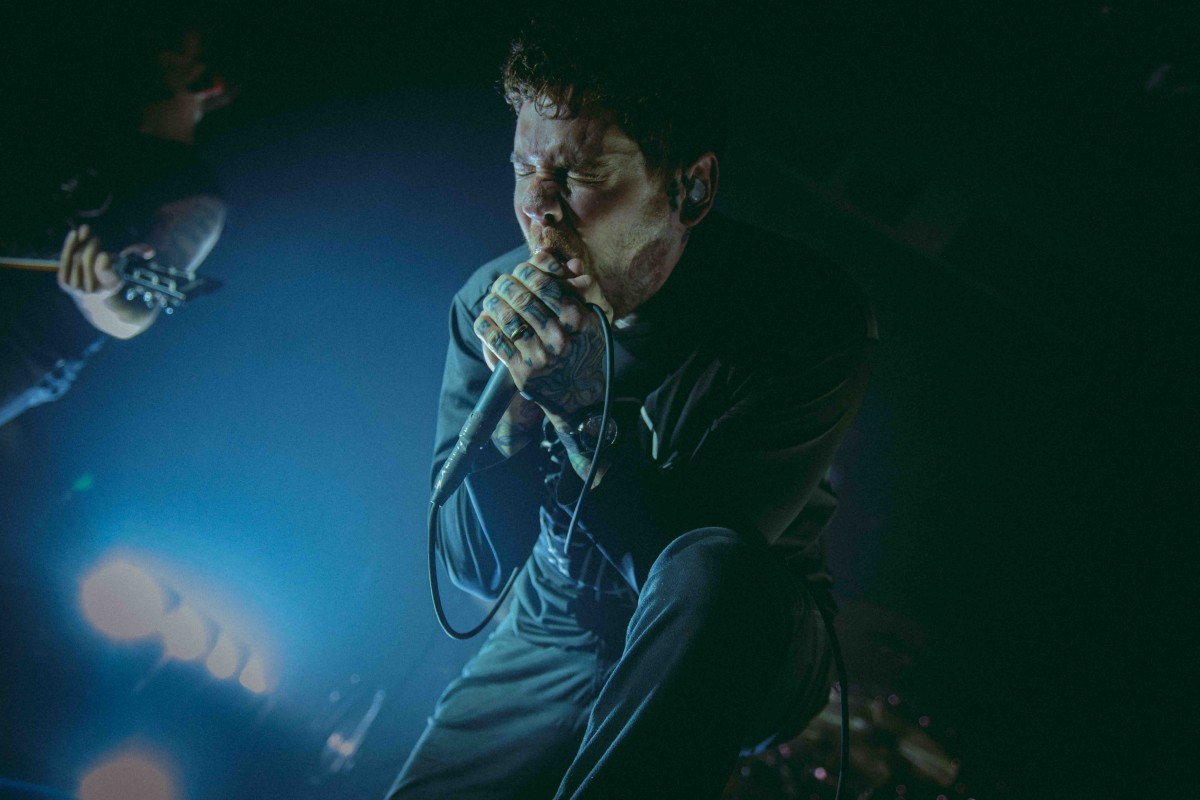
Tobias: Extremely energetic, slightly confrontational. It’s a proper show. It should feel big and grandiose and slightly dangerous. Don’t be passive to this because it’s going to eat you, that kind of vibe. It’s life or death every time. We’re never going to be a cool post-punk band with glasses on. It’s going to be the most real show you’ve seen in a long time.
Benjamin: Hopefully for some people it’ll be a show where you go in not knowing what to expect, and you sit there afterwards with the feeling that this was really good, and you’ll be really glad you came.
Any fun facts or band lore you want to share?
Tobias: This is all of our first band. Me and Ferdinand started in 2011. We’ve kept the same name, changed some old members when we were kids, but this is pretty much the same thing since we were very small kids. That’s pretty huge.
How does this album feel different to your previous releases?
Tobias: Every single moment is very special to this band. It’s the first time we made something that is truly, uniquely only this band. I can say that and believe it, not just as a selling point.
Benjamin: It feels like everything we’ve ever done has built up to this, and we’re finally starting now.
Who would your dream collaborations be?
Benjamin: After this weekend, Deki Alem.
Tobias: They played last at the festival we just played and they’re the coolest group of people I’ve seen in a long time. I also love weird pop music, so Underscore, or Danny Brown. He’s the only rapper capable of rapping over “Blast Off” or “CND”.
Benjamin: Danny Brown would be so fun.
What has been your biggest musical achievement so far?
Benjamin: Signing with Sargent House was a big thing.
Ferdinand: The whole thing around this record might be the biggest achievement yet.
Tobias: Finishing this album and being able to write music I’m still excited about after it’s done. There was a fear that after finishing this album nothing would ever be as good again. I’m happy to say we have new stuff made after this album that is absolutely insane. Getting over that fear is a big achievement.
Benjamin: Also being able to go outside our own country and meet fans from different places in the world and have genuinely exciting conversations with the community. That means a lot.
The album artwork is striking. What was the idea behind it?
Tobias: I had this very vague idea of a warped face that I was trying to explain for a couple of weeks. We did a photoshoot and were close but didn’t quite get the weirdness. Then we did the “Gunning for Free” music video, a lot of which was shot through bendable glass, and the day after we did a photoshoot with and through the glass. That photo is one of those experiments. I’m very proud that there’s no editing, no computer manipulation. It’s just photography. Some of the other shots are truly, really creepy and off-putting. We’ll be publishing more of them at some point.
What experiment has had the biggest payoff?
Tobias: A big part of this album was to not be too precious about the quality of the recording. It was more about the feeling and trusting the vibe. A lot of what you’re hearing is from demo recordings or live recordings. Keeping really ugly parts in the music, keeping actual mistakes just for a vibe. I remember the feeling when I played a guitar part and messed up the last bit but it felt cool, so I left it in because it feels alive. Committing all of that to the album is very rewarding. This is done in a very fragmented way. It’s very loop-based and computer music but also very organic.
What is the most important message you want to get through to your audience?
Tobias: Most of this band is about engagement and moving people physically or emotionally. Since the first EP “Jumping, Dancing, Fighting” the whole thing was about what the music is going to do to you physically. This new album is always reaching out, always addressing the listener. Direct communication, 1:1. The live show is much the same. We very rarely play for ourselves. If you give energy back, we’re going to push that ten times harder back again.
What does the future hold for Hammok?
Benjamin: Who knows. We want to keep growing, taking each day, each song and each show one at a time. It’s like a big ball rolling downhill and it’s never going to stop because the hill just keeps going and the ball keeps getting bigger.
Ferdinand: We want to meet every single person who enjoys the same stuff as we do. We spent our youth feeling like outsiders. We just want to go on the road and keep doing it.
Tobias: This has been going for so long already and it’s very self-sustaining. The inspiration is in the actual thing of doing music. This is the hungriest beast alive and it’s going to keep going. We can self-sustain off the bare minimum, so when you get something actually good it’s proper fuel and it can run you for six months.
Benjamin: Just going on tour and getting through the crap, when you give us a good meal that is going to keep us going for days.
Tobias: Just a warm meal. That’s going to keep us going for two months.
Benjamin: Clean sheets are rare, but when you get them you can do one day in a good hotel and two weeks in the crap, for sure. We’re coming back to the UK for the tour. I’m very excited about that. The 2000 Trees show is going to be very big.
When Does This Place Become Our Scene? is out now via Sargent House

Leave a Reply