
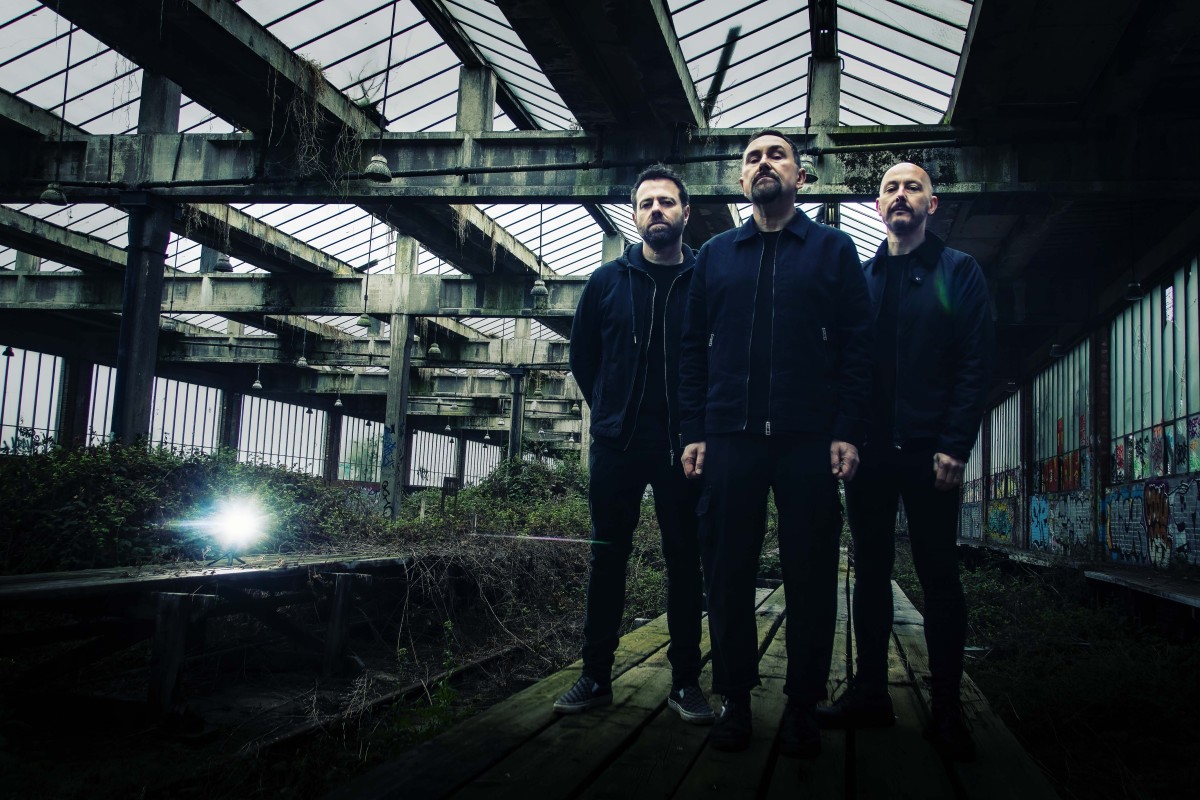

Twenty-three years after it dragged Therapy? back from the brink, High Anxiety is finally getting the vinyl release it was always told it didn’t need. Andy Cairns and Michael McKeegan dig through the original tapes, a stack of forgotten demos and one very uneasy dinner party to tell us how the record that kept them going came together…
Words by Felix Bartlett | Nov 27, 2026
Andy Cairns has spent the morning stalking his postman.
In fairness, he had good reason. Sitting on his doorstep is the first ever vinyl pressing of High Anxiety, Therapy?’s seventh album, a record that has waited 23 years to be cut into wax.
“It actually just arrived today,” he says. “I’ve been stalking the postman.”
It’s a fitting homecoming for an album that arrived at a strange time for the band. By the end of 2001 they’d lost a drummer and a record deal in fairly quick succession. High Anxiety, released in May 2003, was the sound of Therapy? regrouping with new drummer Neil Cooper and a fresh deal, and finding out they still had plenty left in the tank.
So why 23 years, rather than waiting for a big shiny 25th birthday? The honest answer is that nobody planned it. The album originally came out through Eagle Rock, and when Mercury got in touch about taking on a run of the band’s old records, High Anxiety was one of four that came along for the ride.
“It wasn’t a decision,” Andy explains. “Mercury got in touch and said, look, we want to buy the following albums off you. So they got four albums, which means they get a proper release.”
And a proper release means something the record never had first time round.
“At the time, in 2003, we were told that vinyl wasn’t popular anymore, especially with our fanbase,” he says. “So until 2009, none of our records were released on vinyl. It’s good to have it on vinyl, and with extra tracks.”
For Michael, that meant treating it like the vinyl release it should have been all along.
“It’s always a big thrill,” the bassist says. “It was never on vinyl for the original release, so we were really conscious of making it like it would have been back in the day. There was a hidden track on the CD, but we’ve moved that off, because we wouldn’t have had that on a vinyl release. We’ve got the lyrics on it, some nice images and stuff. It’s really cool.
“As any musician knows, when you’re in the room working, you don’t really take that much in apart from the job at hand. So it’s just been great to go back and look at it. I’m delighted with how it looks, and it sounds really good as well.”
Blown up to 12 inches, the first thing that hits you is the sleeve. A surreal, cut-and-paste dinner scene washed in purple, it looks like a family gathering about ten seconds before somebody brings up politics.
It was also, Andy admits, the first time Therapy? let somebody else take the wheel on their artwork. Previous covers had come from friends of the band, but on signing to Eagle Rock they were pointed towards the label’s in-house designer, Curt Evans.
“Usually we have quite a big say in our album covers,” Andy says. “The record company said, look, this is the way the label works, we have someone in house. He sent us a few images and that was one. It was the first time we kind of surrendered our artwork to somebody else, really, which was kind of strange.”
As it turned out, the collage style was right up his street. It took him straight back to the cut-and-paste sleeves of the punk records he’d grown up with, Crass and Dead Kennedys among them.
The band weren’t entirely hands-off, mind. Michael remembers them handing over one non-negotiable.
“I think we decided to tell them that we wanted it to be purple,” he laughs. “That was one of our main things before any of the images came together. So true to form, there’s definitely purple involved.
“Curt didn’t go into it blind, though. He came down to the studio while we were actually recording it, so he had a good idea what was coming down the line. And once we got the title locked in… it does look like a particularly anxious dinner party, if you look at it. That’s everyone’s Christmas, that’s what you’ve got to look forward to. I think he hit the nail on the head.”
“When it’s residential, you can play your guitar solo in your carpet slippers at 11 o’clock at night if you want to” – Andy Cairns
For a record called High Anxiety, the memories it stirs up are surprisingly chilled. Most of that, Andy reckons, comes down to the new man behind the kit.
“It was the first record Neil Cooper was the drummer on, so it was good to have an injection of fresh ideas and energy,” he says. “He was really keen.”
The songs took shape at Real World Studios in Box, just outside Bath, after the studio got in touch and offered the band some free time to demo there. From there, they decamped to Parkgate in Battle, East Sussex, with their own sound engineer Pete Bartlett producing.
“We knew him really well, and it was a residential studio,” Andy says. “By the time we got there, the songs were written and we just had to get good versions of them, so there wasn’t a great deal of pressure on us. We were really pleased with the way the drums had been going.
“We’re very hard working as a band. We know that you can’t just party in the studio or things get lost, but we did have a great time doing it. If you’re in a studio working nine to five, you’re kind of tied to that. But when it’s residential, you can play your guitar solo in your carpet slippers at 11 o’clock at night if you want to. And that’s okay.”
Remasters can be a minefield. Dig out the original tapes of some much-loved records and you’ll find a mess that needs rescuing. High Anxiety, it turns out, needed very little rescuing at all.
“When we got the original tapes transferred with a view to remastering it, the mixes sounded brilliant,” Michael says. “And I can’t say that’s the case for every record. There wasn’t a lot of heavy lifting we had to do for the actual album tracks. Really well played, really well mixed, just great songs.
“One thing that did strike me, this was the first record where we tuned down to C standard, which is quite a bit lower than what we had been recording in, and it still sounds really bright. It doesn’t sound sludgy, it doesn’t sound murky. There’s a real crispness to it.”
It’s not often a musician will happily admit to enjoying their own back catalogue. Michael is the exception here.
“Most musicians will tell you they don’t really care to play their own music a lot, especially a slightly older album,” he says. “But when I heard the original tapes and the remastered version, I was really buzzing. It was like, ‘Wow, this is class.’ There are some really cool vocal effects going on that I’d kind of forgotten were even there. It’s a really sweet sounding record.”
The real treasure, though, is on the second disc. Alongside B-sides and bonus tracks, the deluxe edition gathers up two sets of demos, and one of them stopped Andy in his tracks.
Watch You Go is, by his own description, the sound of his punk roots poking through. Raised on Irish punk like Stiff Little Fingers and The Undertones, plus the Ramones, Sex Pistols and his all-time favourites Buzzcocks, he’s always had a habit of writing short, sharp, hardcore-driven pop songs. On the album, Watch You Go came out as something closer to pop punk.
“It’s kind of like the Misfits meet The Beatles,” he says. “I remember worrying at the time because there wasn’t that much guitar modulation on it. There weren’t many clever little angular guitar parts. It was a bit straightforward pop punk.
“But the four-track version on this CD has got that really gnarly, lo-fi Misfits kind of ’50s shock rock’n’roll thing, which works really well. I hadn’t heard it probably since 2003. When I got the CD and popped it in, I just thought, ‘Wow, that probably should have been on the album.’”
Michael’s pick from the vaults is a very different beast.
“The four-track stuff is really interesting, because that’s it at its most pure and raw,” he says. “We were just in the room, the four of us, throwing in ideas. You’d record it and then move on to the next thing, so it was quite spontaneous. There’s a four-track version of Rust where there’s a whole different middle section that’s kind of like My War-era Black Flag. It just pops in there, and there are some quite demented vocals on it as well.”
Then there’s the song that wasn’t supposed to be there at all. Never Ending, the album’s hidden track, has been lifted off the end of the record for the vinyl and given a proper home on the deluxe CD. It started life, Andy says, as an attempt at something altogether more soulful.
“I did approach it as, should we make it a bit more like an old soul number? And it was met with kind of a blank look by the producer,” he laughs. “So it came out in the vernacular of pop punk, a bit like Watch You Go and My Voodoo Doll. They were the three pop punk ones. I think at the end it was like, well, this is really catchy, but is it really Therapy? So let’s put it on as a hidden track.”
The twist? When the album came out, Never Ending became a favourite with a lot of the journalists who heard it.
“Which is bizarre,” Andy says. “It doesn’t have the smarts that tracks like Rust and If It Kills Me and Stand In Line have. It was almost a bit more throwaway, so we just put it on as a hidden track.”
Ask the pair which song means the most to them, and they head in different directions. For Michael, it’s Limbo, the first new song he heard after Neil joined, sent over as an MP3 after Andy and the new drummer had been rehearsing together up near Derby.
“I was like, ‘Wow, this is brilliant,’” he remembers. “I didn’t even know what it was going to sound like, I had totally fresh ears. It’s a really dynamic song, maybe a tiny bit different to what Therapy? had done before. It’s got that quiet-loud thing, but done in quite a clever way. There’s one brilliant bit with a drop-down verse and this mad drum fill, and in the grand scheme of things it’s probably not what you should do in a song, but it just really fits the mood. It’s heavy, really powerful as well.”
Andy goes for Stand In Line, a song that had to be wrestled into shape. In its earliest form it was a hypnotic, psychedelic thing with an eastern-sounding guitar line, drifting into territory that was, in his words, “no disrespect to Kula Shaker”, a little too far from where Therapy? needed to be.
“We stripped it back so that it was just this big monolithic riff, and we kept the psychedelic side of it to the vocals,” he says. “When I listened back to it, it’s a huge monster of a track. It’s almost got a Led Zeppelin groove to it, this kind of Soundgarden groove, and that’s probably my standout on this one. If you put that track on today and didn’t tell anyone who it was, they’d probably think it was a new band.”
“This is a dread-free environment” – Michael McKeegan
With an album this well loved, is there anything on it they’d dread having to play live?
“No dread, to be honest,” Michael insists. “This is a dread-free environment. We did play them a lot live, and I think we played everything off the album.”
Andy, however, has a confession.
“The only one we haven’t played much, and this would be my dread, is Last Blast,” he says. “We still play If It Kills Me, we still play Rust often. But I think Last Blast was only played on that tour in 2003, and we’ve never ever played it since. So it’s not dread at the song itself. It’s dread at me having to go back and rehearse stuff I played over 20 years ago.”
“That’s true, actually,” Michael chips in. “I think I might know how to play the main riff, but nothing else.”
Twenty-odd years on from that tour, both are adamant that the music world they’re returning to is in rude health, at least creatively. Andy has little patience for peers who get misty-eyed about the old days.
“Most of my peers, when I talk to them, go on about the ’90s, and I say, ‘My God, you sound like my dad,’” he says. “It really makes me cross. I’m always going to see new music, and I think rock music, alternative rock, whatever you want to call it, is in an incredibly good place. Underground punk’s in a brilliant place.
“The only thing I fear for younger bands is the financial side of things. We’ve been lucky. Over these 30-something years we’ve been a professional band, we’ve paid ourselves, paid mortgages, put children through school. But I know young musicians who have three or four jobs, trying to juggle things just to make it work. Music becomes a hobby, and I think it’s more important than that. Any of the creative arts, you should be able to make a living from.”
Michael agrees.
“There’s so much great music out there, it’s actually really hard to keep up with it all,” he says. “But unfortunately the financial rewards don’t really reflect the creativity and the work young bands are putting in. It’s a grind for most bands now. And their ambition is not to buy a sports car. It’s to make another record, or to go and play their music to people in Europe and across the world.”
As for Therapy? themselves, 2027 is already looking busy. There’s a new album on the way, with new singles in the new year, a full UK and European tour and some big festivals to follow, all due to be announced in January.
“All will be revealed,” Michael teases. “We’re very close to letting people know all about it, but we just don’t want to jump the gun.”
“We’re all incredibly proud of it,” Andy adds. “We’re all buzzing about it.”
Twenty-three years after High Anxiety helped put Therapy? back on their feet, that feels about right.
Leave a Reply