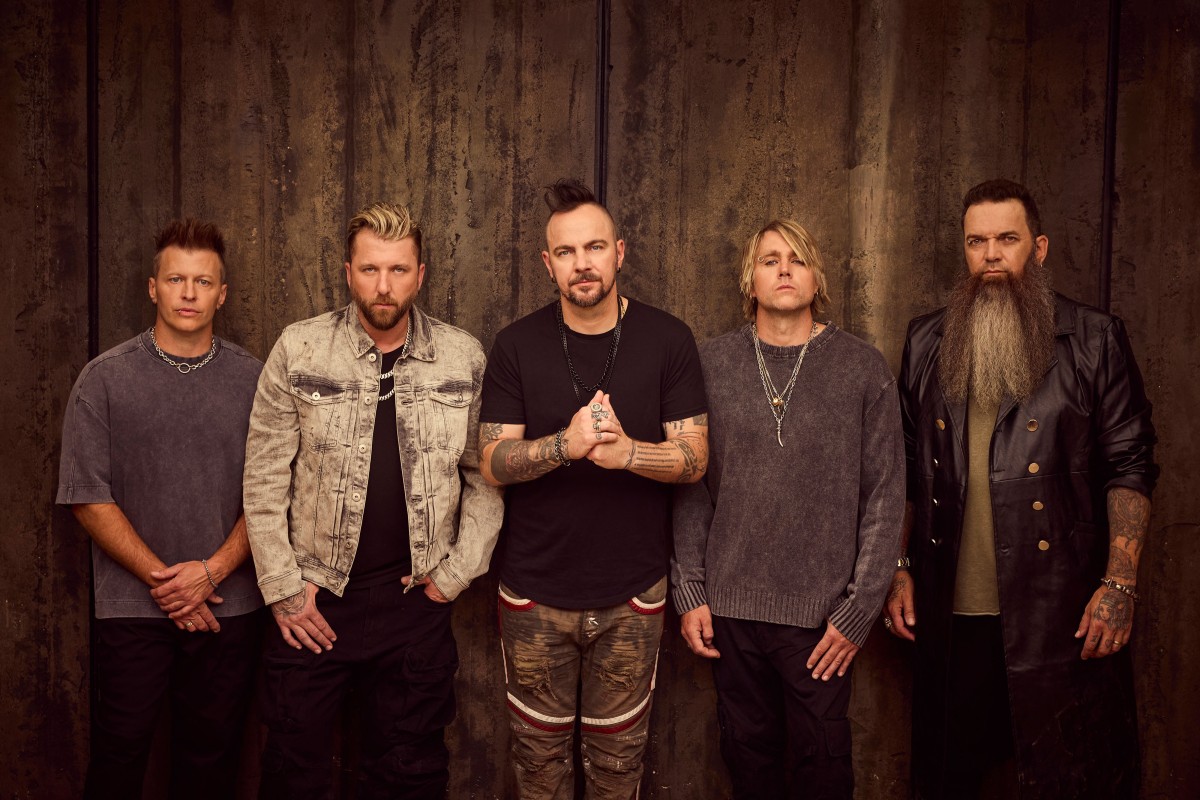

Speaking with AMPED, Three Days Grace’s Adam Gontier discusses his growth from his initial departure from the band, finding inspiration in unlikely places and how the fans have remained at the forefront of the band’s motivations…
Words by Paulina Subia | 26 Aug, 2025
In the early 2000s, it was impossible to escape Three Days Grace. The Canadian rock band found instantaneous success with the release of their self-titled debut album in 2003, developing a devoted fan base that latched onto their signature melancholy. Building on a foundation that dates back to their childhood, the band channelled adolescent memories and a mutual love of Seattle grunge into three more albums — One-X (2006), Life Starts Now (2009), and Transit of Venus (2012), earning international recognition among metal heavyweights of the era.
Then, in 2013, vocalist Adam Gontier left the band. Struggles with inner demons and an open battle with addiction called for a period of solitude, during which he tested out a solo career on the road. The remaining members of Three Days Grace — guitarist Barry Stock, drummer Neil Sanderson and bassist Brad Walst — enlisted Walst’s younger brother, Matt, to join them on vocals, releasing the first of three albums, Human, in 2015 (followed by 2018’s Outsider and 2022’s Explosions).
Gontier’s return was first teased on social media in October 2024, revealing studio sessions referred to as “Three Days Grace 2X”. Soon, it was confirmed that Gontier would rejoin the band alongside Matt on vocals, and the surprise twist of two vocalists was received positively by fans old and new. Now, with the release of their new album, Alienation, Three Days Grace have come back rejuvenated and matured — while still leaning into their familiar sound.
Speaking with AMPED, Gontier discusses his growth from his initial departure from Three Days Grace, finding inspiration in unlikely places and how the fans have remained at the forefront of the band’s motivations.
How has tour life been treating you this time around?
Adam Gontier: It’s been great. With this new tour, the new Three Days Grace setup has been awesome. Everybody’s having a really good time, the shows are going well and the crowds are into it. It’s been a lot of fun so far.
What’s it been like for you, returning to Three Days Grace, reconnecting with fans on tour and debuting this new era?
I think the first thing with making all this happen was getting together with the guys and seeing how it all played out. We sat down to write some new songs, and once we got in the room together, everything was easy. It was almost like we hadn’t taken time off; it was pretty crazy.
We did this mainly for the fans. I had done four [Three Days Grace] albums, and Matt had done three, [so] it made sense. I felt like the fans would really enjoy it, and they have.
Three Days Grace has a really unique connection with its fans, which is really special to see. There has been such a positive reception about having you back in the band and now, having two singers in you and Matt. How have you perceived this connection grow over time, since the beginnings of Three Days Grace, and how do you hope it grows?
We started the band when we were 14 years old. When we put out the first album [Three Days Grace, 2003], we were pretty young and watching how the whole thing has grown has been crazy. We never, ever would have thought that we would be around this long, with this many albums and songs out there.
I think we’ve always written from a place of trying to release feelings and write about real-life situations, and that’s been the common thread with the music that has really stuck with the fans. Fortunately, we have a pretty awesome and incredibly loyal fan base.
In one interview I’d come across, you described your return as feeling like ‘the right time’ to do it. What has gone down over the last 12 years or so that has motivated you to finally jump back into it?
It’s no secret that over the years, I’ve battled with addiction. I had a lot of demons that I had to deal with, so when I left the band in 2013, I wasn’t in the greatest mindset. At the time, I wasn’t actually using, but I was in a pretty terrible spot and had to change something in my life, and [leaving the band] was it. Over the years, I’ve grown up quite a bit; I think all of us have, really. We all have young kids and things are different now. The stuff that used to matter when we were younger — more superficial stuff — doesn’t really matter anymore.
We all realised that we’re all in this for the same common goal: we just want to make the fans happy, and we want to tour and put out music. The biggest change [was] growing up, living a little bit more and learning about what’s really important.
During that time, you explored a solo career and worked with a ton of cool people [including the formation of supergroup Saint Astonia and collaborating with Daughtry, Breaking Benjamin and more]. What did those projects inspire in you most, and what have you carried from them into today?
When I initially left [Three Days Grace], I did have the thought and plan of doing an acoustic album. I did a couple of small tours, just me and a guitar, which was a fun, creative outlet at that time. I did a lot of collaborating with different artists and songwriters. I think the process of using outside writers really opened my mind, creatively. Now, with Three Days Grace, we have good friends and songwriters that we work with. It’s a lot of fun to sit in a room with six people and come up with ideas, shooting them back and forth. For me, being open to that and being happy with doing that now is a big thing.
Since the beginning of Three Days Grace, a lot of your lyrics candidly address sensitive subjects, such as mental health. How do you perceive using songwriting a a tool to address those topics, and how has your relationship with writing changed or shifted over time?
When we were growing up and first started writing music, we were really influenced by the Seattle bands: Nirvana, Pearl Jam, etc. Our style of writing has always been about personal stuff and the ‘darker’ things. A lot of the time, it’s about feeling alone. Even in groups of people, with a lot of people out there, we still feel alone, and I think that’s a common thread that we’ve always held on to and tend to write about.
Regardless of how things look on the outside, there’s always something going on inside. Music is an outlet for that — for me, anyway. It always has been and it always will be.
The new album, Alienation, has some deep self-reflection across the lyrics. There seems to be a very evident self-awareness, as well, with an understanding of the ways that people perceive you and the inability to control that. I’m wondering if that resonates, and if there are other sentiments that you found yourself returning to during the writing process?
We all went through a lot of things over the last few years. We’ve lost some people in our lives; some of us have battled and continue to battle with substances, drinking, that sort of thing. The lyrics that we write always come back to pain. A song like ‘Apologies’ was, for all of us, very personal. It’s a song about somebody offering you help, but you feel like you don’t really deserve it. The record’s very personal to all of us, in a lot of different ways.
How do you go about trying to find a balance between vulnerability in your lyrics while trying to retain some things for yourself, if at all?
I think that’s one of the benefits of writing with a few people in a room. You have your ideas, and it helps to have others offering their thoughts on what they like. It’s one of those things where, if you’re sitting around the room together and everybody agrees that an idea or lyric is the best it can be, then it usually is. There’s definitely a balance of being vulnerable and trying to stay true to what you want to write, but it does help when everyone is involved.
What is something that was at the forefront of your mind that you knew you wanted to bring into this new phase of Three Days Grace, maybe something that you wanted to change or something new to try with the rest of the guys?
On Alienation, I think we were all in agreement that we wanted to make an album that complemented what I did with the band years ago; there’s the classic first [self-titled] album, One-X and Life Starts Now vibe. But we also wanted to make sure that we incorporated the newer stuff that Matt had written. We also worked with a couple of different producers. One in particular, Dan Lancaster, offered a lot of different elements musically and sonically. I think we all agreed that we wanted to capture what makes Three Days Grace special on both sides, and I feel like we did that… [At the beginning of recording Alienation], we weren’t exactly sure how to do that. The songwriting process with the band has always kind of stayed the same, but we wanted the sound to be a collaboration of what we’d both done.
I tend to write lyrics all the time, so I have a couple of notebooks full of lyrics and stuff. But when we’re writing together, it always starts with the music. Usually, somebody has a good idea for a riff or chorus, and we’ll build around that… Then, I can go to the notebooks and see if some lyric ideas work for that kind of vibe.
In your own definition, what is it about Three Days Grace that is most special and was key to harness on Alienation?
For me, it’s cool, raw riffs with very personal lyrics and powerful melodies. It’s tough to pinpoint it, but like I was saying earlier, the whole Seattle scene was so big for us. It was always about the power in the lyrics and the melodies. Now, we experiment a bit [and go] outside of that box, but there’s a lot of that early vibe happening on this album, as well.
With Alienation, did you have any inspirations (lyrically or sonically) that you found yourself coming back to during the writing and recording process?
Jeff Buckley. Obviously, he’s a bit different than our style of music. But [listening to] his haunting melodies and guitar parts, and the different things he used to write, I always find myself coming up with melodies. And then I’ll think back and go, ‘Oh, that’s from this Jeff Buckley song.’ I have influences from everywhere, but I find myself falling back to him.
I understand that you and Matt have known each other for a long time. Now that you’re both at the helm, what is something unexpected that came about from your collaboration?
I’ve known Matt since he was about eight years old, when I first met Brad. He was just a little kid, you know? I’d go over to Brad’s place for dinner after school and Matt would be there, causing chaos at the dinner table and stuff. So, I watched him grow up. He was always around, watching us rehearse, and then his band, My Darkest Days, came out on tour with us and we spent a lot of time on the road with them.
Matt’s always sort of been a part of the whole thing [with Three Days Grace]. Before we were bandmates, we were friends, really close friends. So, I think that’s what we are now. We’re still friends, but we’re doing something that we really love to do — getting on stage and singing — and doing it together is really cool. We trade off [singing] parts, and it’s those little moments on stage where he messes up a line, or I mess up a lyric, and we can look at each other and smile. It’s really cool to have the camaraderie on stage again.
That’s cool to hear, especially as I’d imagine that having two singers comes with its own difficulty of trying to balance out both of your places on stage and whatnot. But, as you said, having that foundation from when you both were kids manifests itself in a new way now.
Absolutely. I feel like that’s really the reason that this whole thing works. We were so close growing up, before the band got big and stuff, so we do have that foundation. Growing up in a really small town of a thousand people, we’re all still small-town guys; we haven’t gone away from that. There are no egos in the band. When we were younger, first starting and having all the success, there was a little bit of up and down with egos, myself included. Things kind of get out of control. But now, everybody’s left their ego at the door. Nobody cares; we just want to have fun and we want the fans to enjoy it.
Is there a personal favourite track from Alienation that you feel defines this new era for you?
I think on this album, there’s such a variety of sounds, and each song has a bit of a different feel, so it’s a tough one. I really do think that ‘Mayday’ is the best representation of the band now and how we’re putting ourselves out there, with both Matt and me singing and sharing parts. I feel that a track like ‘In Waves’ is pretty vintage Three Days Grace; it probably could have gone on the album One-X if we had written it back then. There’s ‘Don’t Wanna Go Home Tonight’, which is a song that we all really love because it’s a throwback to early 90s grunge. It’s kind of all over the board, but I think ‘Mayday’ is a good representation of who we are right now.
With younger generations finding your records today, what has it been like for you to see a mix of old & new fans in the crowd? What are you hoping they take away from this new phase of Three Days Grace?
During this past year of touring, we’ve noticed a lot of our fans from 20 years ago who are obviously older, and they have kids with them. So, it’s pretty cool to see that Music-wise, I hope it’s one of those things where the music helps them. But it’s very cool to see different generations. It does make me feel a little old, though!
What’s something that you wish you could have told yourself when the band was first forming?
To slow down. Being young, I was in all sorts of bad stuff, so I didn’t really take it all in; it was kind of just a big whirlwind. I don’t necessarily remember a lot of it because it all happened so fast. I’d probably tell my younger self to just slow down, relax and take everything in.
Alienation is now now via RCA Records
Leave a Reply